
The Engineering Anatomy of Modular Expansion Joints: Ensuring Long-Term Bridge Integrity
Article content and related resources
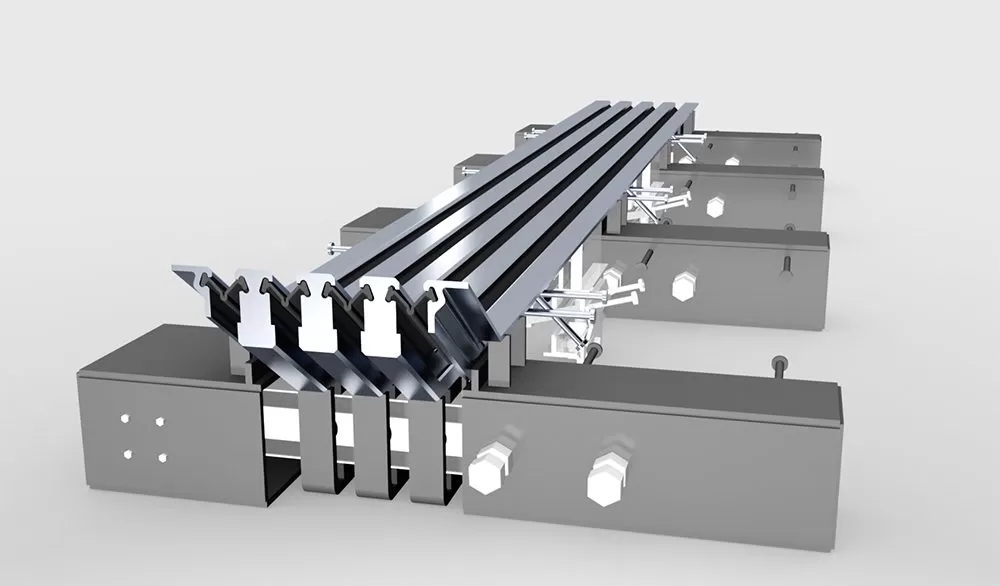
For bridge engineers and infrastructure project owners, specifying the correct movement joint is a critical decision that directly impacts lifecycle costs, structural safety, and traffic flow. Standard expansion joints are often inadequate for the complex forces exerted on long-span, curved, or heavily trafficked bridges. The solution requires a sophisticated engineering approach: the modular expansion joint system.
These are not off-the-shelf components; they are precision-engineered systems designed to manage multi-directional displacements ranging from 80 mm to over 2,000 mm. This article provides a deep technical dive into the engineering principles, component functionalities, and critical selection criteria for these systems, moving beyond surface-level definitions to offer practical insights for specifiers and asset owners. We will also explore how modern engineering and manufacturing, such as that provided by KINGWORK, are setting new benchmarks for performance and reliability.
The Engineering Imperative: Why Standard Joints Fail
The conventional wisdom often underestimates the dynamic and static forces acting on a bridge deck. Temperature fluctuations cause significant thermal expansion, while live traffic loads induce constant vibration and fatigue. Seismic events introduce sudden, high-magnitude forces. Standard finger or strip seal joints typically reach their functional limit at around 80-100 mm of movement. Beyond this threshold, the risk of structural fatigue, seal failure, and water ingress increases exponentially. For large-span bridges, viaducts, and highway interchanges, a modular bridge expansion joint is not merely an option; it is an engineering necessity.
The Achilles' Heel of Large Movements
When a bridge expands and contracts, the deck ends move. A joint must accommodate this movement while remaining watertight and capable of withstanding heavy axle loads. Without a robust system, water penetrates the substructure, leading to corrosion of steel reinforcement and bearings. This degradation is often invisible during routine inspections but compromises the entire structure's integrity. Furthermore, a failed joint creates a dynamic impact load on the bridge ends, accelerating deterioration. Therefore, the modular expansion joint is the primary defense against these cascading structural failures.
Deconstructing the Modular System: An Internal Anatomy Lesson
To appreciate the performance of a modular expansion joint, one must understand its internal architecture. Unlike simpler joints, it is an integrated system of interdependent components, each engineered for a specific load or movement function.
The Core Components and Their Critical Roles
The system's reliability hinges on the synergy between its parts. They operate much like a sophisticated mechanical machine buried within the bridge deck.
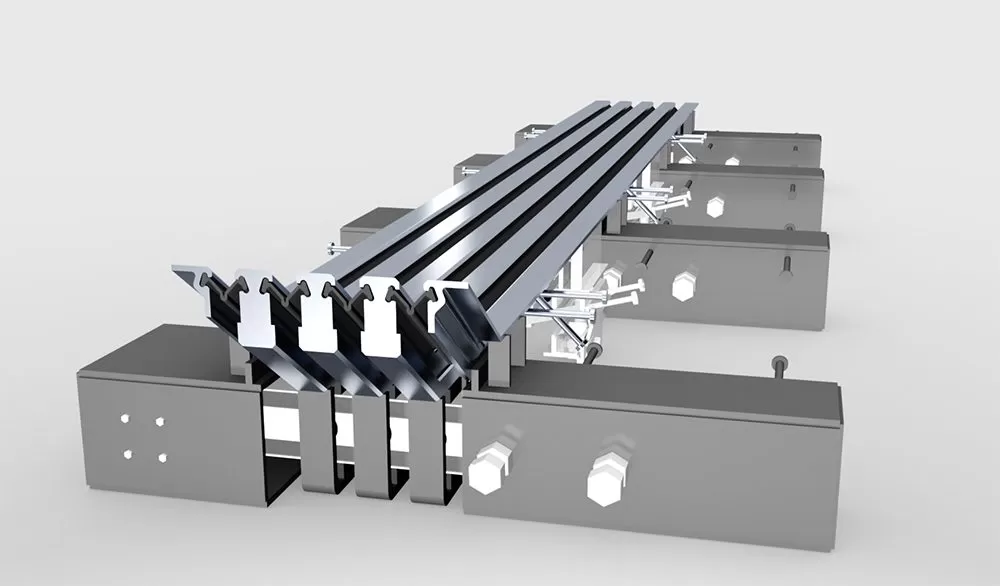
Center Beams: These run longitudinally across the gap, providing the running surface for traffic and supporting the elastomeric seals. They are designed to carry both vertical wheel loads and horizontal braking forces, transferring these to the support beams.
Edge Beams: Securely anchored to the concrete deck or abutment, these form the fixed boundaries of the joint assembly. Their role is to absorb loads from the center beams and protect the anchorage zone from impact and environmental ingress.
Support Beams (Cross Beams): These are the primary load distributors. Running transversely, they transfer the vertical forces from the center beams to the main bridge structure. Many designs incorporate rotational and sliding capabilities to accommodate complex structural movements.
Pantograph Control System: This is the "brain" of the modular expansion joint. It is a variable-length linkage mechanism that ensures equal spacing between all center beams during expansion or contraction. Without precise control, the load distribution becomes uneven, leading to premature wear and stress concentration.
Elastomeric Sealing System: This is the primary barrier against water and debris. Depending on the design, these are either box seals or strip seals made from high-durability EPDM or silicone. While they do not carry loads, their integrity is paramount for substructure protection.
Control and Prestress Elements: These prevent uplift and ensure that the beams remain in constant, secure contact during movement. They absorb reaction forces and ensure the joint can handle torsional movements often experienced on skewed or curved bridges.
Critical Selection Criteria: Beyond the Movement Range
While movement capacity is the primary metric, specifiers often overlook the operational nuances that dictate long-term success. A truly effective modular expansion joint selection process must evaluate three critical dimensions: load transfer dynamics, watertight integrity under fatigue, and maintenance accessibility.
1. Load Transfer and Fatigue Resistance
Every component, from the center beams to the support beams, is subject to millions of load cycles over the joint's lifespan. The design must account for both vertical loads and horizontal shear forces caused by braking and acceleration. Inadequate crossbeam spacing or insufficient steel grade leads to fatigue cracking. Engineers should demand modular expansion joint systems validated through rigorous dynamic load testing, simulating decades of traffic within a compressed timeline.
2. The Sealing Efficiency Paradox
Watertightness is often stated as a feature, but the mechanics of achieving it under dynamic movement are complex. The elastomeric seals must maintain compression against the steel beams while accommodating significant angular and longitudinal displacement. Seal failure often begins not from a catastrophic tear but from "pumping" – the repetitive suction and release of water during traffic passage. High-performance modular expansion joint systems incorporate mechanically locked seals that resist this pumping effect, ensuring decades of leak-proof performance.
3. The Challenge of Skewed and Curved Decks
Standard straight joints perform poorly on skew or curved bridges. The induced lateral and rotational movements can bind the control systems, leading to uneven beam spacing and premature failure. For these applications, a modular expansion joint must feature a robust control mechanism capable of handling differential movement across the span. Systems like those engineered by KINGWORK are specifically designed to handle these complex geometries, utilizing advanced bearing plates and crossbeam configurations to ensure uniform movement distribution, even under high skew angles.
Installation and Quality Control: The Human Factor
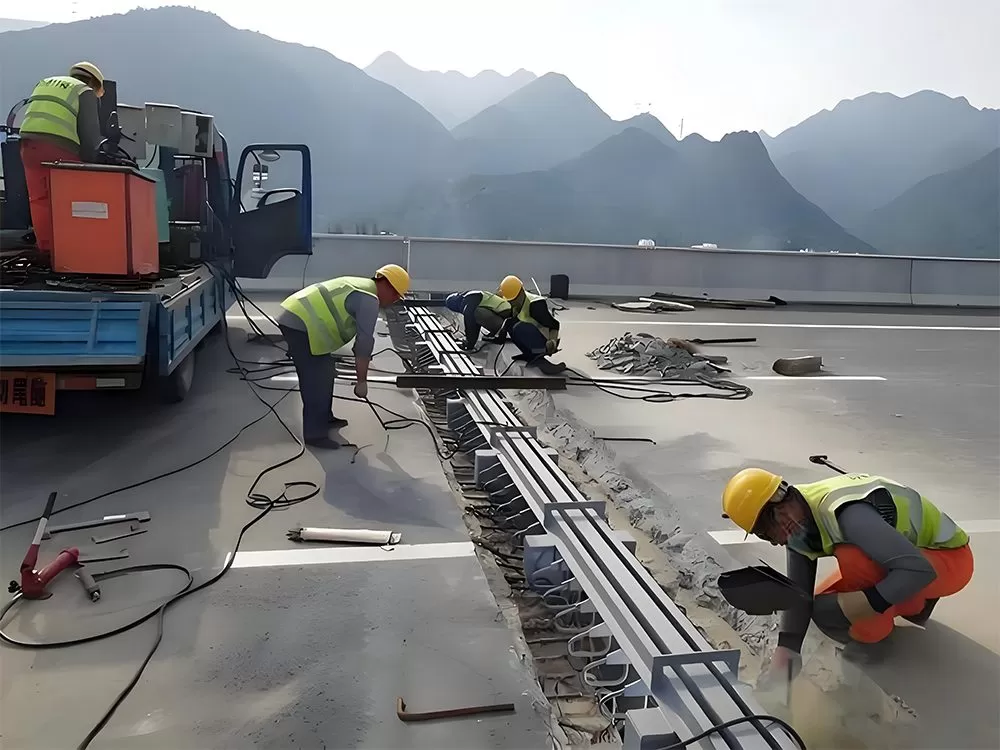
Engineering excellence on paper can be undone by poor installation practices. The complexity of a modular expansion joint demands a high degree of precision during placement. The anchorage is critical; concrete breakout or inadequate reinforcement embedment are common failure points.
Anchorage Zone Design: The forces from the joint are only as strong as the concrete it attaches to. Proper dowel bar placement and reinforced edge beams are mandatory.
Shimming and Levelling: The riding surface must be perfectly flush with the deck. Variations of even a few millimeters create high-impact dynamic loads that can shatter concrete edges and damage bearings.
Curing and Backfill: High-strength, non-shrink grout or concrete must be used for the backfill, with strict adherence to curing protocols. Compromising here creates a direct path for water ingress and structural weakening.
Lifecycle Cost Analysis (LCCA): The Long View
Often, procurement decisions are driven by initial capital expenditure. However, for critical infrastructure like bridges, the lifecycle cost presents a vastly different picture. A low-cost, poorly designed joint will require frequent seal replacements and partial repairs, often disrupting traffic and incurring significant user delay costs.
Investing in a premium, durable modular expansion joint significantly extends the maintenance interval. The ability to replace individual components (like seals or bearings) without demolishing the entire joint is a key feature of leading systems like those from KINGWORK. This "serviceability" drastically reduces long-term costs and traffic disruptions, making the higher initial investment economically viable over the bridge's service life.
KINGWORK: A Legacy of Precision and Performance
In the global infrastructure market, experience is the ultimate arbiter of quality. KINGWORK brings over a decade of specialized engineering expertise to every modular expansion joint project. Their systems are not merely fabricated; they are engineered to meet the specific seismic, thermal, and load requirements of each unique structure. By separating the load-bearing frame from the displacement control system, KINGWORK ensures that their joints maintain stability under the most dynamic traffic and environmental conditions.
Field-proven across varied climates and heavy traffic environments, KINGWORK's commitment to precision manufacturing, material science, and rigorous testing ensures that their modular expansion joint solutions provide a watertight, durable, and low-maintenance interface that protects the structural integrity of bridges for decades.
Future-Proofing Infrastructure: The Intelligent Joint
The evolution of the modular expansion joint is moving towards "smart" infrastructure. The integration of sensors to monitor displacement, load distribution, and seal integrity is becoming a reality. This data allows for predictive maintenance, alerting asset managers to potential issues before they become critical failures. As we look to the next generation of long-span, high-load bridges, the modular expansion joint will continue to be the critical interface between structural engineering and traffic safety, ensuring our transportation networks remain resilient for the future.
Frequently Asked Questions (FAQ)
Q1: What is the primary difference between a modular expansion joint
and a standard strip seal joint?
A: The key differentiator is
movement capacity. A standard strip seal joint typically handles movements up to
80mm. A modular expansion joint utilizes a multi-beam system
(center beams and crossbeams) with a pantograph control mechanism to accommodate
large movements, often exceeding 80mm and reaching up to 2,000mm or more. This
makes modular joints essential for long-span and complex bridges.
Q2: How does a modular expansion joint ensure watertightness despite
such large movements?
A: The watertightness is maintained through
high-durability elastomeric seals (box or strip seals) that are mechanically
locked between the steel center beams. These seals are designed to maintain
compression and resist "pumping" or extrusion during the sliding and rotational
movements of the beams, creating a continuous barrier against moisture and
debris.
Q3: What are the most common causes of failure in modular expansion
joints?
A: The most common failure points are (1) fatigue cracking
in the support beams or center beams due to inadequate load testing, (2)
concrete failure in the anchorage zone due to poor installation or design, (3)
premature wear or extrusion of the elastomeric seals, and (4) malfunction of the
control system (pantograph) leading to uneven beam spacing and load
concentration.
Q4: Can a modular expansion joint be repaired, or does the entire
unit need to be replaced?
A: One of the significant advantages of a
high-quality modular expansion joint is serviceability.
Individual components, such as the elastomeric seals, bearings, or even center
beams, can often be replaced without full demolition of the joint assembly. This
greatly reduces maintenance costs and traffic disruption compared to replacing
the entire unit.
Q5: How do seismic design requirements affect the selection of a
modular expansion joint?
A: In seismic zones, the joint must not
only accommodate thermal and live loads but also large, rapid displacements and
rotations during an earthquake. The joint must have a robust mechanical control
system to maintain even spacing and structural integrity post-seismic event.
Furthermore, the anchoring system must be designed to withstand these extreme
forces without brittle failure, maintaining a safe ride surface even after the
event.
Q6: How does the movement range of a modular expansion joint (e.g.,
up to 2000mm) impact the design of the bridge substructure?
A: The
substructure (piers and abutments) must be designed to accommodate the reaction
forces generated by the joint at its maximum displacement. The design must
account for the high longitudinal forces transmitted from the control system and
crossbeams to the supporting concrete. A poor design or incorrect load
calculation can lead to concrete cracking and bearing failure under the
deck.
Secure Your Infrastructure with Precision Engineering
Choosing the right partner for your bridge expansion system is a decision that echoes for decades. At KINGWORK, we combine rigorous engineering design with high-grade materials to deliver modular expansion joint solutions that excel in durability, safety, and performance. Whether your project involves a highway overpass, a curved viaduct, or a complex long-span bridge, our systems are engineered to meet your specific movement and load requirements.
Don't leave your critical infrastructure to chance. Contact KINGWORK today to discuss your project specifications and discover how our expert team can deliver a tailored, resilient solution for your next major infrastructure project.
![Bridge Joint Types: The Complete Engineering Guide [2026 Edition]](https://www.kwbridgebearing.com/storage/non_theme/202606/024.webp)