Modular Bridge Expansion Joint: Key Advantages — The Definitive Performance Standard
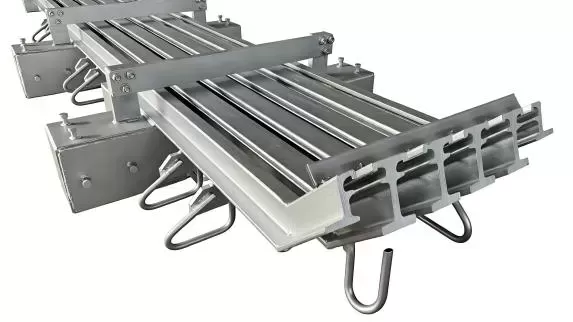
The Modular Bridge Expansion Joint transcends the category of a standard bridge component. It is a bespoke, engineered mechanical system designed to address the most complex structural challenges where conventional solutions fail. Its advantages are not merely incremental improvements; they represent a fundamental shift in capability, reliability, and partnership, engineered to build absolute trust with stakeholders responsible for landmark infrastructure.
1. Engineered Dominance: Unmatched Technical Performance for Extreme Conditions
The system's core advantage is its ability to transform structural vulnerability into a point of guaranteed strength.
Mastery of Complex Kinematics: Unlike simpler joints, it is explicitly engineered for multi-directional displacement control. It doesn't just "allow" movement; it actively manages simultaneous longitudinal, transverse, vertical, and rotational movements. This is non-negotiable for curved bridges, seismically active zones, and skewed decks, where forces are not uniaxial. The system's articulated design ensures predictable performance under these complex loading scenarios, preventing binding, overstress, and premature failure.
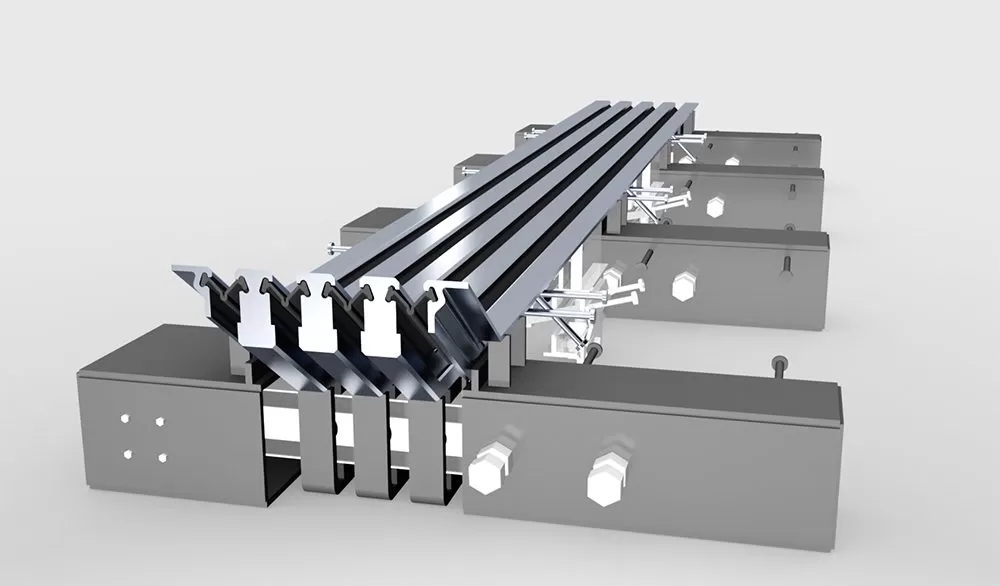
High-Capacity Load Transfer as a Structural Element: It functions as an integral load-bearing component of the bridge deck. Heavy axle loads are not merely borne by the riding surface but are directly and efficiently transferred through its network of steel center beams and support boxes into the main structure. This engineered load path provides exceptional fatigue resistance under decades of heavy truck traffic, ensuring structural integrity where it matters most.
2. Lifecycle Integrity: Engineered for Durability and Operational Continuity
The value proposition extends far beyond initial installation, focusing on decades of reliable, cost-effective service.
Durability by Design and Material Science: Utilizing high-grade, low-alloy structural steels and advanced corrosion protection systems (e.g., hot-dip galvanizing, specialized marine coatings), the system is built to withstand aggressive environments—coastal salt spray, de-icing chemicals, and industrial pollution. Critical moving parts and bearings are designed for wear resistance, and elastomeric seals are formulated for long-term ozone and weather resistance.
Proactive Maintenance and Long-Term Economy: The modular design is a paradigm for ease of inspection and maintenance. Individual components, such as seal bands or wear plates, can be accessed and replaced with minimal traffic disruption and without dismantling the entire system. This "design for maintainability" philosophy translates into dramatically lower lifecycle costs, predictable maintenance budgets, and maximized bridge uptime, delivering superior long-term value for asset owners.
3. Partnership Through Customization and Global Execution
We provide more than a product; we deliver a custom-engineered solution backed by global execution certainty.
Precision OEM Customization: Every major bridge is unique. We engage in true OEM-level engineering collaboration, tailoring the joint's movement capacity, load rating, geometric configuration, and material specifications to the precise demands of your project's finite element analysis and site conditions. This ensures a perfect fit, both physically and performance-wise.
Guaranteed Compliance and Supply Chain Certainty: Our products are designed and validated to meet or exceed global standards (AASHTO, EN, JIS). Compliance documentation is integral to our delivery. Our controlled, large-scale manufacturing facilities ensure rigorous quality control, production consistency, and reliable lead times, de-risking your project schedule and eliminating supply chain uncertainty.
Global Expertise and End-to-End Support: Our experience spans continents and bridge typologies. This global perspective means we understand not just the product, but the context of its application—from local regulatory environments to site-specific construction practices. We provide comprehensive support from initial concept engineering and installation supervision to long-term maintenance planning, serving as a trusted technical partner throughout the asset's lifespan.
Conclusion: The Foundation of Trust for Critical Infrastructure
In summary, the key advantages of the Modular Bridge Expansion Joint coalesce into a single, powerful promise: engineered certainty for your most critical bridges. It offers:
Technical Superiority to solve complex structural problems.
Lifecycle Resilience to protect long-term investments.
Partnership Integrity through customization and reliable execution.
Specifying this system is a decisive action that moves beyond component procurement. It is an investment in risk mitigation, performance validation, and enduring trust for the bridges that define skylines and sustain economies. It is the unequivocal choice where engineering ambition meets the uncompromising requirement for safety and durability.
Modular Bridge Expansion Joint: Installation & Construction — Precision Engineering in Practice
The installation of a Modular Bridge Expansion Joint is the critical phase where its engineered superiority is physically realized. This is not a simple construction task but a precision alignment and integration process that demands expert execution. Our methodology transforms this complexity into a controlled, reliable procedure, directly extending the product's technical advantages from the design office to the bridge deck, thereby building unparalleled client trust through demonstrable on-site competency and certainty.
Core Installation Philosophy: From Engineered Component to Integrated System
Our approach is governed by the principle that the joint must be installed as a perfectly calibrated mechanical system, not merely fitted as a construction element. This philosophy ensures its multi-directional and load-bearing capabilities are fully activated.
Precision Planning and Pre-Assembly: Critical to success is work done off-site. Major sub-assemblies, including support boxes and center beam modules, are pre-assembled and trial-fitted in our controlled factory environment. This allows for precise verification of dimensions, alignment of moving parts, and function testing before shipment. This step drastically reduces field fitting uncertainty and prevents costly on-site rework.
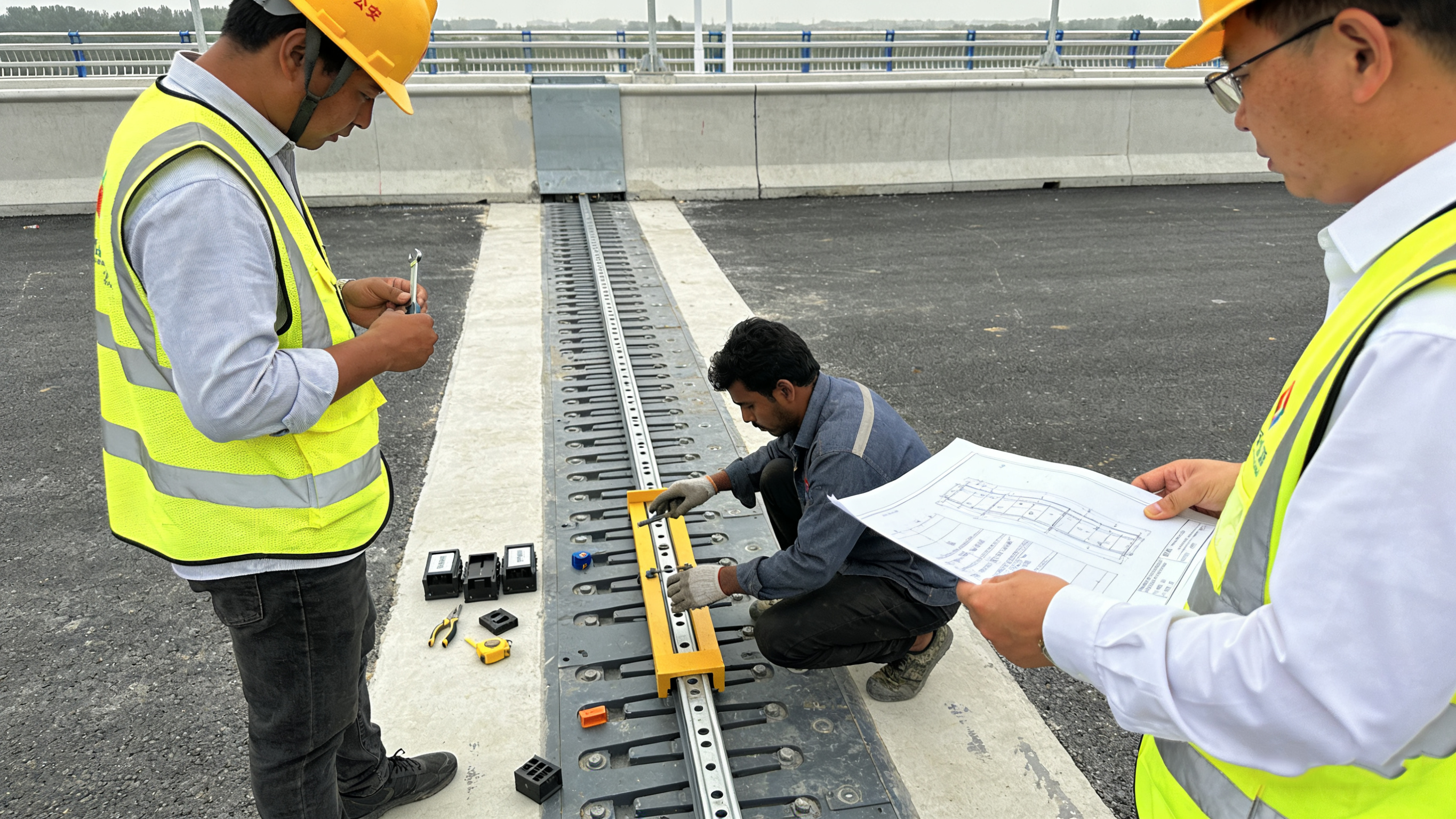
Staged, Sequenced Integration: Installation follows a strict, pre-defined sequence that aligns with the bridge's construction critical path. The process is segmented into clear stages—support structure placement, center beam installation, sealing system integration, and final commissioning. Each stage has verified checkpoints, ensuring quality is built in progressively.
Tolerance Management and Adaptive Fitting: We acknowledge real-world site variations. The design incorporates adjustable elements (e.g., leveling screws, slotted bolt holes) within the support system. This allows our trained installation teams to make fine, on-site adjustments to achieve perfect alignment and elevation, compensating for minor deviations in the concrete deck, thus guaranteeing optimal performance.
Step-by-Step Construction Methodology: A Showcase of Technical Rigor
The installation sequence is a direct reflection of the product's engineered logic, building confidence at every step.
Phase 1: Foundation & Support System Installation
Activity: Precise positioning and securing of the anchor systems and transverse support boxes/beams onto the bridge deck ends. This is the foundational "chassis" for the entire joint.
Technical Advantage & Trust Builder: We provide laser-guided templates and custom jigs specific to the project. Our engineers supervise or validate the initial positioning to micron-level tolerances. This meticulous start ensures the entire system's long-term kinematic performance is rooted in perfect alignment, showcasing our commitment to foundational accuracy.
Phase 2: Center Beam Module Installation & Alignment
Activity: Lifting and placing the pre-assembled steel center beam modules into the support structure. Each module is then painstakingly aligned both longitudinally and transversely.
Technical Advantage & Trust Builder: The modular design shines here. Individual beams can be placed and adjusted without disrupting the entire assembly. We use digital surveying equipment to verify the even spacing and parallel alignment of all beams, which is critical for smooth movement and uniform load distribution. This visible precision reinforces the high-tech nature of the product.
Phase 3: Integration of Kinematic & Sealing Systems
Activity: Installation of the sliding bearings, control springs (for Spring Type), or scissor hinge mechanisms (for Hinge Type), followed by the placement of the continuous elastomeric seal bands between the center beams.
Technical Advantage & Trust Builder: This phase activates the joint's core intelligence. The proper setting of spring pre-load or hinge clearance is performed by our specialists according to project-specific calculations, ensuring the designed restoring force and movement behavior. The sealing system installation, often using specialized tensioning tools, demonstrates our focus on long-term waterproofing integrity from day one.
Phase 4: Commissioning, Load Testing & Handover
Activity: Removal of all temporary locking devices, manual cycling of the joint through its range of motion, and final inspection. A comprehensive commissioning dossier is prepared.
Technical Advantage & Trust Builder: We conduct a formal on-site functional test, often witnessed by the client's engineer, to visually demonstrate smooth, unrestricted movement in all designed directions. This final verification provides tangible, immediate proof of correct installation and system readiness, transforming design promises into observable performance.
The Technical Support Ecosystem: Your Installation Safety Net
Trust is cemented by the robust support framework that surrounds the physical installation.
Dedicated Installation Engineering: A dedicated project engineer is assigned to develop the Installation Method Statement (IMS), a step-by-step guide tailored to your bridge's specific conditions and constraints.
On-Site Technical Supervision: We provide optional certified installation supervisors to be on-site during critical phases to direct crews, perform quality checks, and solve unforeseen challenges in real time, ensuring strict adherence to specifications.
Training & Knowledge Transfer: For clients and preferred contractors, we offer installation certification programs, turning your teams into proficient experts, which builds long-term capacity and trust.
Digital Documentation & As-Built Records: The entire process is documented with photos, verification reports, and final as-built drawings, creating a permanent digital record for future maintenance reference.
Conclusion: Building Trust Through Executed Excellence
The installation of a Modular Bridge Expansion Joint is where our technical claims are validated and client trust is ultimately won. By elevating installation to a precision engineering discipline, we ensure that the joint's inherent advantages in load capacity, multi-directional movement, and durability are fully realized in the structure. We provide not just a product, but a guaranteed outcome—a perfectly functioning, high-performance system integrated into your bridge. This turnkey approach, from design to commissioned installation, minimizes owner risk, validates the engineering investment, and establishes our partnership as the definitive choice for projects where performance cannot be left to chance.