5 Ways Advanced Modular Joints Protect Bridges During Extreme Seismic Events
Article content and related resources
When a severe earthquake strikes, bridge decks undergo violent, erratic kinematic displacements. Longitudinal shaking can push adjacent spans toward each other or drag them apart by several feet. Without specialized structural interfaces, these massive inertial forces lead directly to deck unseating or catastrophic pounding damage at abutments and piers.
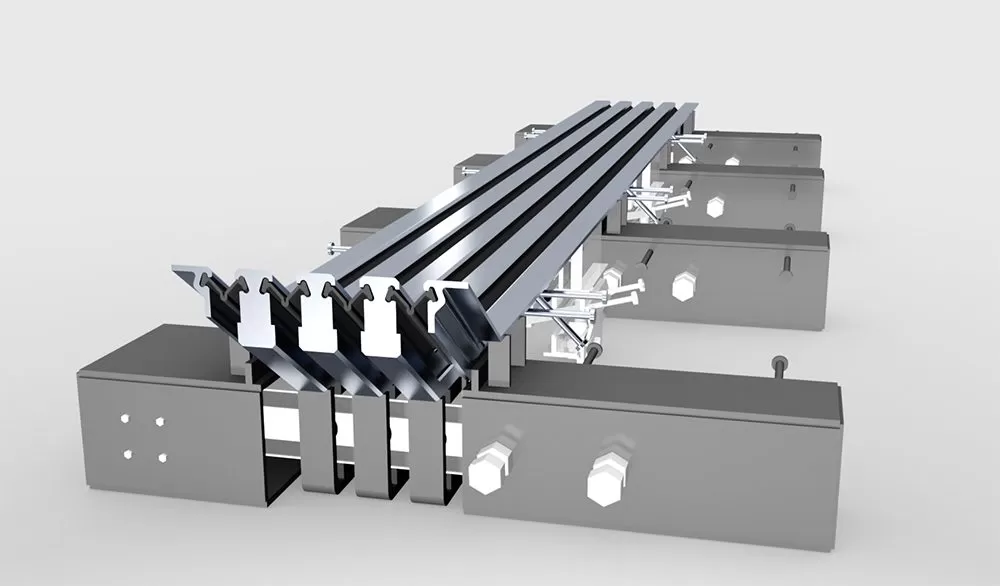
Modern engineering treats expansion systems as active defensive mechanisms rather than simple road surface fillers. Advanced modular joints serve as the primary mechanical safety valve across long-span structures. At KINGWORK, our engineers manufacture heavy-duty expansion assemblies designed to withstand these violent seismic demands while keeping critical infrastructure fully functional.
If you are drafting plans for a high-demand crossing or retrofitting an older structure in a high-seismic zone, submit your structural displacement criteria to KINGWORK today for custom joint design options and project quotes.
1. Absorbing Multi-Directional Large Displacements
Seismic ground motions rarely follow a single straight line. Ground displacement waves travel along unpredictable axes, combining severe longitudinal translation with transverse shearing and vertical pitching. Traditional finger plates or single-gap elastomeric joints lock up instantly when confronted with these coupled motions.
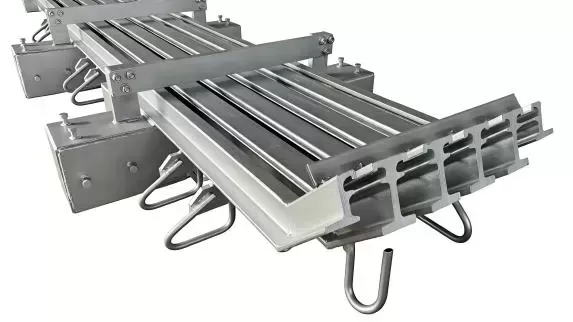
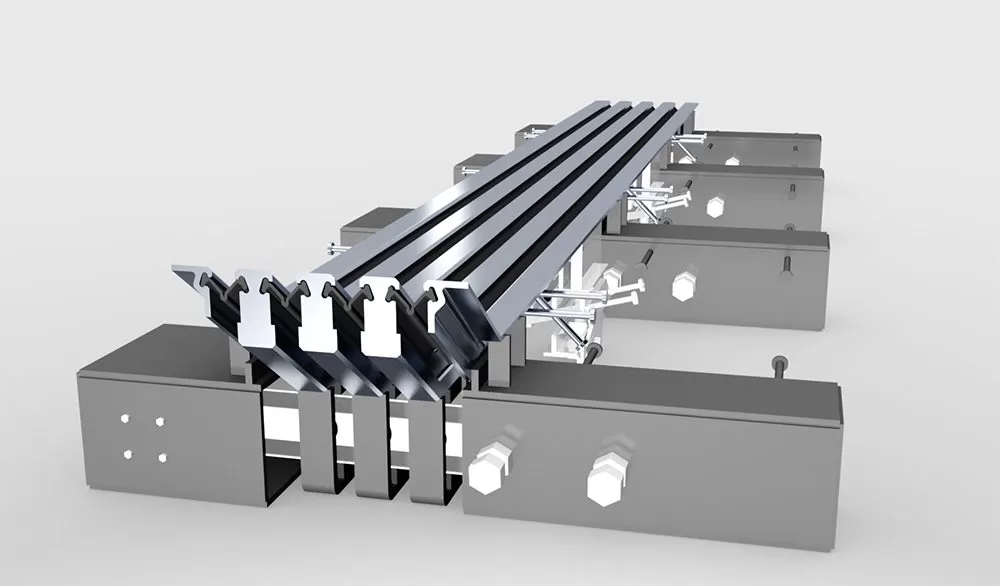
Advanced modular joints solve this problem through articulated kinematic systems. Using a swivel joist system, the support bars underneath the road surface rotate dynamically on sliding bases. This mechanism allows the individual center beams to slide apart evenly, even when the bridge superstructure undergoes significant skew angles or lateral drifts.
- Longitudinal displacement accommodation: Modern multi-gap systems can manage total movement strokes exceeding 2,000 mm during Maximum Considered Earthquake (MCE) events.
- Transverse shear management: Swivel mechanisms allow individual joists to articulate up to 30 degrees off-axis without binding or buckling the road beams.
- Rotational flexibility: Polyurethane spring elements absorb torsional twist between adjoining bridge decks without popping the steel profiles out of their anchorages.
By absorbing extreme multi-directional movement without mechanical lockup, modular expansion joints prevent bridge girders from transferring destructive lateral bending moments down into the substructure piers.
2. Mitigating Impact Energy to Prevent "Bridge Pounding"
Bridge pounding occurs when out-of-phase seismic vibrations cause two adjacent spans to hammer violently against each other. The dynamic impact forces generated during this impact can easily crush concrete deck ends, sheer off anchor bolts, and blow out backwalls at the abutments.
Modern modular expansion joints act as progressive mechanical arrestors. They use durable elastomeric control springs and polyurethane buffer zones positioned directly between the support joists and transverse center beams. As seismic motion forces the expansion gap closed, these components compress progressively, converting raw kinetic energy into elastomeric deformation.
- Equidistant control systems: Resilient springs ensure the gap between individual center beams remains balanced during normal daily thermal shifts.
- Non-linear dynamic resistance: Under high-velocity seismic compression, these springs stiffen, dampening peak kinetic forces before steel-on-steel impact occurs.
- Structural cushioning: Heavy rubber impact pads placed behind the terminal beams dissipate shockwaves, protecting the structural deck edges from brittle failure.
This kinetic mitigation significantly cuts the peak impact forces transmitted into bridge abutments. By preventing uncontrolled impact, modular joints keep bridge decks seated securely on their primary support caps.
3. Providing Fail-Safe Anti-Uplift and Shear Resistance
Near-fault ground motions often produce intense vertical accelerations. These seismic waves throw bridge decks upward before slamming them down onto bearing seats. If an expansion joint lacks vertical retention, this uplift will dislodge internal components, spit out watertight seals, and leave lethal hazards across the roadway.
Advanced modular joints resolve this vulnerability through integrated anti-uplift sliding bearings. Engineers bolt or weld these low-friction bearings directly beneath each support joist, mechanically clamping the internal bars to the embedded bridge substructure. Even under severe vertical uplift forces, the sliding bars cannot leap out of their guide tracks.
Furthermore, leading designs incorporate intentional fuse mechanisms for rare extreme events. If earthquake displacements exceed the maximum design limit, sacrificial shear bolts or break-away anchor plates snap under controlled stress levels. This release allows the joint system to shift safely without cracking the bridge deck or tearing out the concrete rebar cages.
4. Protecting Bearings and Substructures from Overload
High-performance bridge bearings—such as spherical bearings, pot bearings, and lead-rubber isolators—are costly and difficult to replace after an earthquake. When an expansion system binds or locks prematurely, it transfers unmitigated horizontal forces into these structural bearings, causing shear tear-out or permanent base-plate slippage.
Advanced modular joints regulate load paths dynamically during seismic cycles. By moving smoothly along low-friction PTFE or ultra-high-molecular-weight polyethylene (UHMWPE) sliding sheets, the joint keeps frictional resistance below three percent of the total vertical load. At KINGWORK, our structural engineers evaluate dynamic friction factors to ensure that modular joint reactions never overload fragile pier caps.
- Reduced horizontal transfer: Smooth mechanical movement prevents high friction forces from overwhelming lateral shear keys.
- Isolated deck dynamics: The expansion assembly allows neighboring bridge frames to oscillate at their natural periods without transferring destructive resonance loads.
- Substructure preservation: By eliminating premature joint binding, costly bridge piers experience only the pure bending moments calculated in the original seismic design models.
This protective buffer preserves the elastic integrity of substructures, saving transport authorities millions of dollars in post-earthquake structural repairs.
5. Ensuring Immediate Post-Earthquake Serviceability
A bridge that survives an earthquake structurally is useless if emergency vehicles cannot cross its surface. Traditional expansion joints often buckle, pop their seal plates, or rip apart into jagged metal hazards, blocking critical access routes for fire trucks, ambulances, and emergency supplies.
Modern modular joints focus heavily on rapid post-event transit. Thanks to high-tensile structural steel profiles, reliable control springs, and secure anchoring, these systems maintain a flat, drivable roadway deck during and immediately after high-magnitude seismic events.
- Watertight seal retention: High-performance EPDM or polychloroprene strip seals stay clamped inside the steel beam profiles, preventing bridge runoff from washing into open sub-gaps.
- Anti-skid driving surfaces: Integrated diamond surfacing or serrated steel edges ensure uninterrupted traction for emergency response fleets.
- Rapid inspection and reset: Modular support bar mechanics allow fast post-event inspections, simple spring adjustments, and minimal downtime without requiring deep deck demolitions.
Preserving functional transit access turns major bridge crossings into dependable emergency routes that accelerate community recovery operations.
Engineering Standards & Selection Criteria
Selecting the right modular joint requires strict alignment with recognized international structural design codes. Structural engineers and project managers must verify that the specified assembly meets the dynamic criteria outlined in primary standards, including:
- AASHTO LRFD Bridge Design Specifications: Section 14 mandates rigorous fatigue life testing (Fatigue Limit State) alongside extreme movement testing for modular expansion joint systems.
- Eurocode 8 (EN 1998): Part 2 addresses seismic design of bridges, specifically targeting movement capacity during design seismic events without structural unseating.
- AASHTO LRFD Construction Specifications: Section 19 provides precise guidelines on installation tolerances, pre-compression settings, and blockout concrete anchoring requirements.
When selecting joints for seismic zones, designers must establish the true Maximum Considered Earthquake (MCE) movement demand. Always factor in thermal variables, concrete creep, structural shrinkage, dynamic wind drift, and out-of-phase seismic deflections before locking in the final gap count and joist depth.
Frequently Asked Questions
Q1: What separates a modular expansion joint from a basic strip seal
joint during an earthquake?
A1: A single-gap strip seal joint
handles small thermal shifts (up to 80 mm or 3 inches) along a single line. In
contrast, modular expansion joints link multiple steel center beams and support
joists together. This design accommodates large longitudinal shifts exceeding
2,000 mm, along with multi-directional transverse rotation and vertical movement
during earthquakes.
Q2: How does a swivel joist modular joint handle transverse seismic
shaking?
A2: Swivel joist systems utilize support bars that pivot on
rotary sliding bearings rather than remaining fixed at a 90-degree angle. When
an earthquake induces lateral or racking deck movements, the joists rotate
dynamically. This action maintains uniform spacing between center beams without
jamming the steel profiles.
Q3: Can damaged modular joints be repaired quickly after a major
seismic event?
A3: Yes. Modern modular joints feature modular
internal components. Structural bearings, control springs, and strip seals can
be inspected, reset, or replaced from below or through minimal deck openings. As
long as the primary concrete anchor cages remain intact, full joint demolition
is rarely necessary.
Q4: Why are anti-uplift bearings critical for modular expansion
joints in active fault zones?
A4: Vertical seismic waves create
rapid upward and downward deck accelerations. Without anti-uplift bearings,
support joists can lift out of their tracks. This destroys the mechanical
equalization system and creates hazardous road obstacles for moving traffic.
Q5: How do engineers determine the right number of gaps for an
earthquake-rated modular joint?
A5: Engineers calculate the total
thermal movement range, concrete shrinkage, and creep, and add these to the
out-of-phase dynamic seismic displacements generated by dynamic structural
models. They divide this total calculated movement stroke by the maximum
movement capacity of an individual seal gap (typically 65 mm to 80 mm per cell)
to determine the required beam count.
Build Seismic Resilience into Your Bridge Infrastructure
Mitigating extreme seismic forces demands proven mechanical engineering, precision fabrication, and reliable materials. Advanced modular joints protect bridges from costly pounding damage, absorb complex three-dimensional movements, and maintain functional emergency corridors when communities need them most.
At KINGWORK, we produce robust, rigorously tested bridge expansion systems designed to meet international engineering standards. Our technical specialists collaborate directly with bridge engineers and infrastructure contractors to deliver durable, field-proven solutions tailored to strict project requirements.
Ready to finalize your bridge expansion plans? Contact our engineering support team at KINGWORK today to discuss project parameters, obtain detailed structural submittals, or request a complete quotation for your next development.