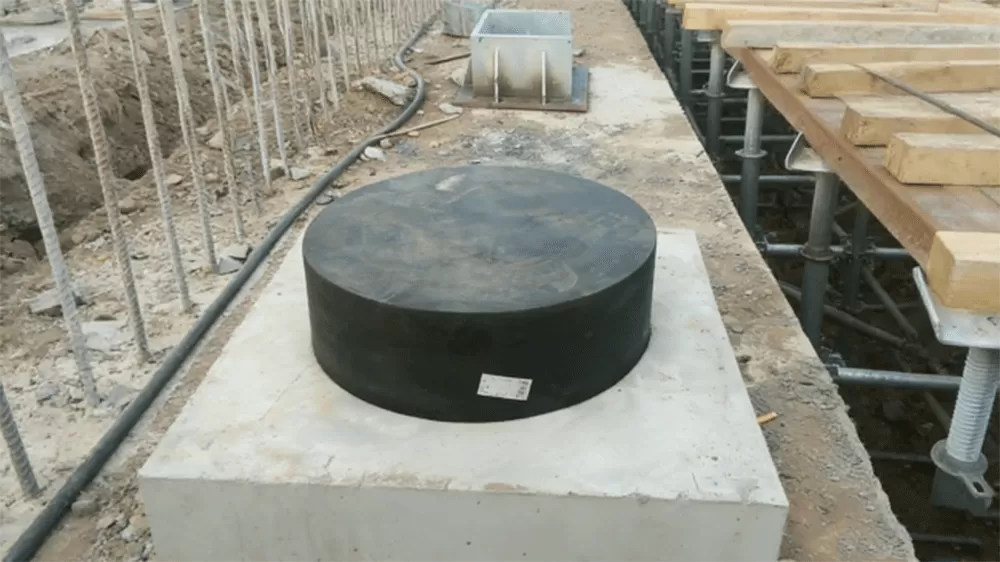
Neoprene Bearing Engineering Guide: Mechanics, Design Standards, and Specifications
Article content and related resources
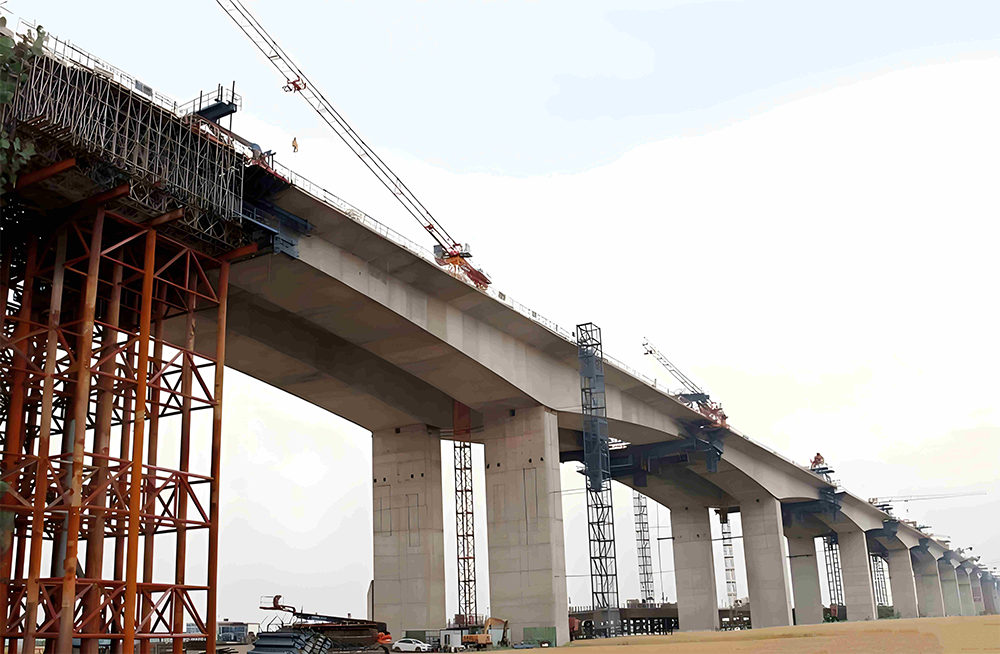
Modern bridge engineering requires the controlled dissipation of kinetic energy, thermal expansion cycles, and rotational deflections induced by live vehicular loading. Bridge superstructures continuously deform under the influence of environmental thermal gradients, braking forces, concrete shrinkage, and seismic excitations. Among the primary mechanical devices used for thermal and dynamic load transfer, the neoprene bearing serves as an essential kinematic interface between the bridge superstructure and substructure, accommodating multi-directional displacements while maintaining vertical dead-load stability.
The operational longevity of a bridge relies heavily on the performance of its isolation and load-transfer units. When elastomer compounds undergo excessive dynamic shearing or extreme weather exposure without adequate compounding design, premature degradation of the substructure occurs. Understanding the physical chemistry of elastomers, the kinematic behavior of reinforced elastomeric units, and global testing standards is fundamental for structural engineers and infrastructure asset managers specifying elastomeric systems.
Material Science: Polychloroprene Chemistry and Compounding Mechanics
Polychloroprene—the synthetic rubber polymer synthesized via the emulsion polymerization of 2-chlorobutadiene—exhibits chemical attributes superior to natural polyisoprene in environmental exposure resistance. The chlorine atom integrated into the polymer backbone lowers the electron density of the double bond, creating resilience against atmospheric ozone attack, chemical oxidation, dynamic flex fatigue, and petroleum-based degradation.
Raw polychloroprene gum requires vulcanization compounding to achieve structural stiffness. The compounding matrix consists of:
Elastomer Base: 100% virgin chloroprene polymer, specifically classified as crystallization-resistant (e.g., Neoprene WRT or equivalent grades), preventing cold-temperature stiffening in sub-zero environments.
Reinforcing Fillers: Semi-reinforcing carbon black grades (such as N550 or N774) dispersed evenly to regulate tensile strength, dynamic tear resistance, and Shore A durometer hardness without inducing internal hysteretic heat generation.
Metal Oxide Vulcanizing Agents: A non-sulfur curing system based on zinc oxide ($ZnO$) and magnesium oxide ($MgO$) acting as chlorine acceptors and vulcanization activators, establishing thermally stable carbon-carbon cross-links.
Antioxidants and Antiozonants: Microcrystalline waxes and substituted p-phenylenediamines that bloom slowly to the component surface, creating an impermeable chemical barrier against atmospheric ozone.
Structural engineering specifications formulated by manufacturers such as KINGWORK prioritize low-temperature crystallization resistance through vulcanization optimization. If the polymer crystallization kinetics are miscalculated, glass transition takes place prematurely at temperatures between -10°C and -25°C, resulting in sudden modulus escalation, loss of rotational flexibility, and excessive horizontal shear stresses transferred directly to bridge substructure piers.
Structural Mechanics: Shape Factor, Vertical Stiffness, and Shear Deformation
The mechanical performance of an elastomer pad under compressive stress is governed by the kinematic constraints imposed on its lateral bulging. Unreinforced elastomers possess minimal compressive modulus due to their low bulk compressibility paired with unrestricted lateral bulging. The integration of steel reinforcement plates creates a composite structural device where lateral strain is mechanically constrained through chemical vulcanization bonding.
The mathematical evaluation of compressive capacity begins with the geometric Shape Factor ($S$), defined as the plan load area divided by the perimeter area free to bulge:
For a rectangular pad with length $L$, width $W$, and individual internal elastomeric layer thickness $t_i$:
S = (L × W) / [2 × (L + W) × t_i]
For a circular bearing with diameter $D$ and individual elastomer layer thickness $t_i$:
S = D / (4 × t_i)
As the shape factor increases, the apparent compressive modulus of elasticity ($E_c$) escalates non-linearly. The theoretical relationship is governed by the shear modulus ($G$) and the bulk modulus ($E_b$):
E_c = 3G(1 + 2kS²)
Where $k$ is an empirical compounding factor ranging between 0.55 and 0.75 based on durometer hardness. Under this mechanical relationship, the performance envelope of an elastomeric neoprene bearing depends directly on its physical geometry and boundary constraints.
Shear Modulus and Translational Kinematics
Translational displacement in the bridge superstructure is accommodated entirely through simple shear strain of the elastomer layers. The horizontal shear stiffness ($K_h$) of the assembly is calculated using the total effective elastomer thickness ($T_e$), excluding internal steel plates:
K_h = (G × A) / T_e
Where $A$ represents the effective plan bonded area. Structural engineering standards generally limit the maximum operational shear strain ($\gamma_s$) under service limit state conditions to $\gamma_s \le 0.50$ (50%), where:
\gamma_s = \Delta_s / T_e
Limiting shear strain to this performance boundary prevents localized delamination at the elastomer-steel interface, eliminates yield instability, and prevents long-term hysteretic internal fatigue.
Rotational Capacity and Eccentricity Management
Girder live-load deflections and camber variations induce rotational angles ($\theta$) across the transverse and longitudinal axes of the bearing. Rotational accommodation occurs via differential compressive strain across the opposite edges of the elastomer. Total rotational capacity depends on ensuring that the minimum compressive strain calculated at the unloaded edge remains positive, preventing tensile lift-off that could trigger physical displacement, edge unseating, or localized stress concentrations exceeding design limits.
Plain vs. Steel-Reinforced Structural Configurations
Proper identification of bridge boundary conditions requires distinguishing between an unreinforced elastomeric pad and an internally reinforced neoprene bearing is foundational for structural design.
Plain Elastomeric Pads (PEP)
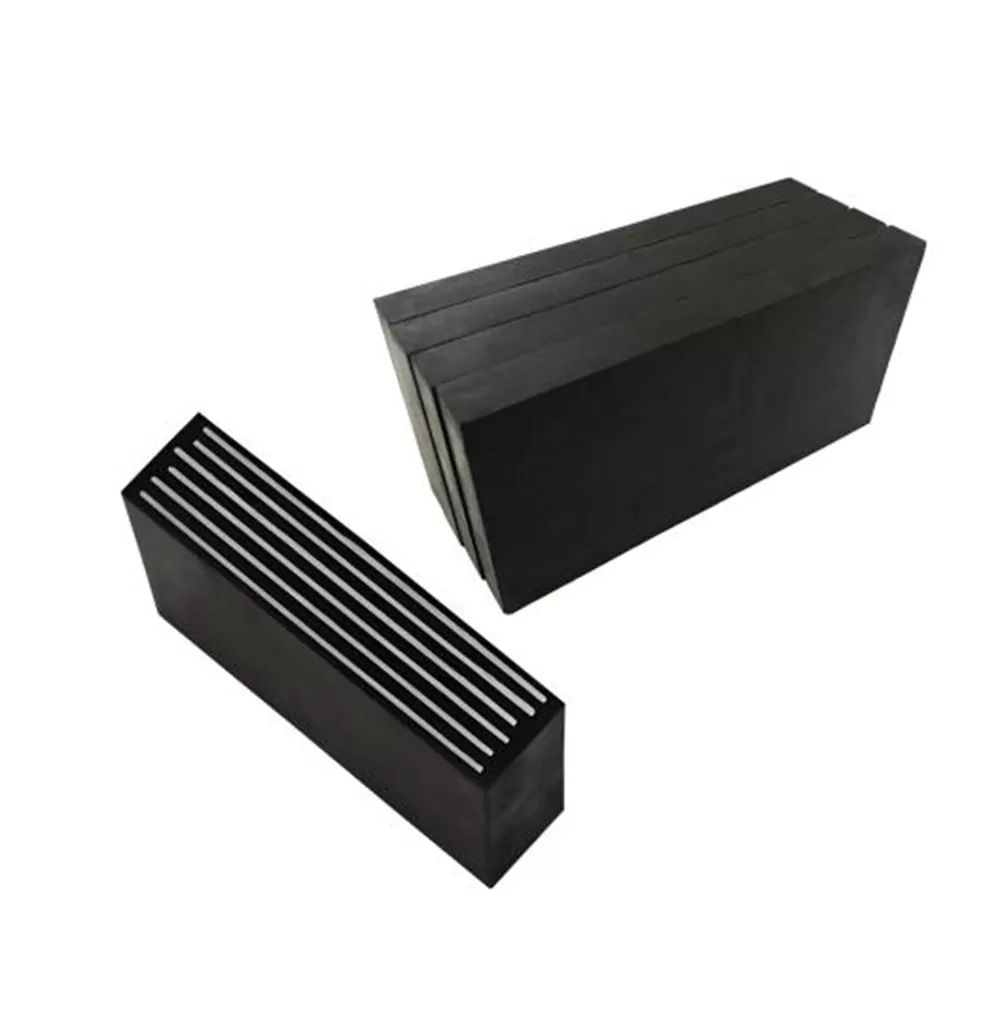
Plain pads consist of unreinforced vulcanized chloroprene sheets cut to specified plan dimensions. Characterized by low shape factors (typically $S < 5$), these components exhibit significant lateral bulging under nominal vertical stress. Their structural application is limited to short-span precast concrete slabs, culverts, building load paths, and bridge approach spans where vertical loads are low (typically below 5 MPa) and rotational demand is minimal.
Steel-Reinforced Elastomeric Bearings
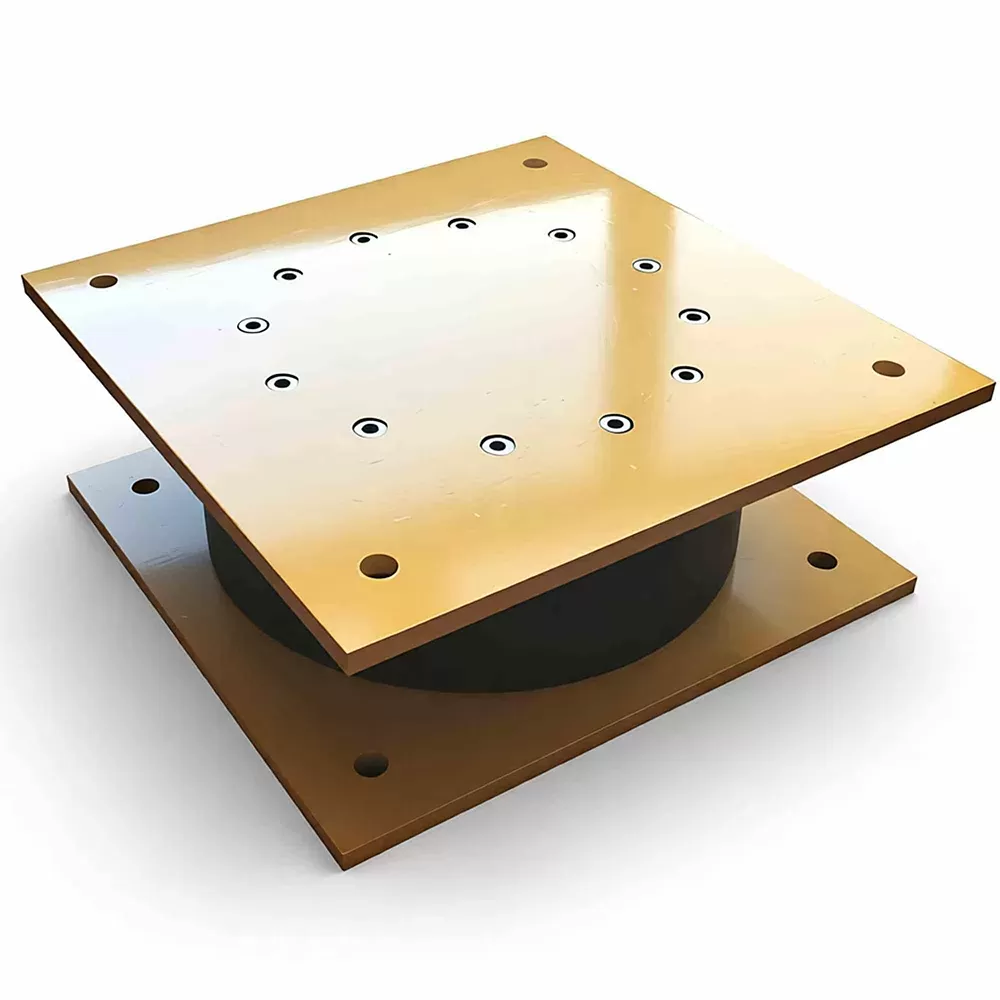
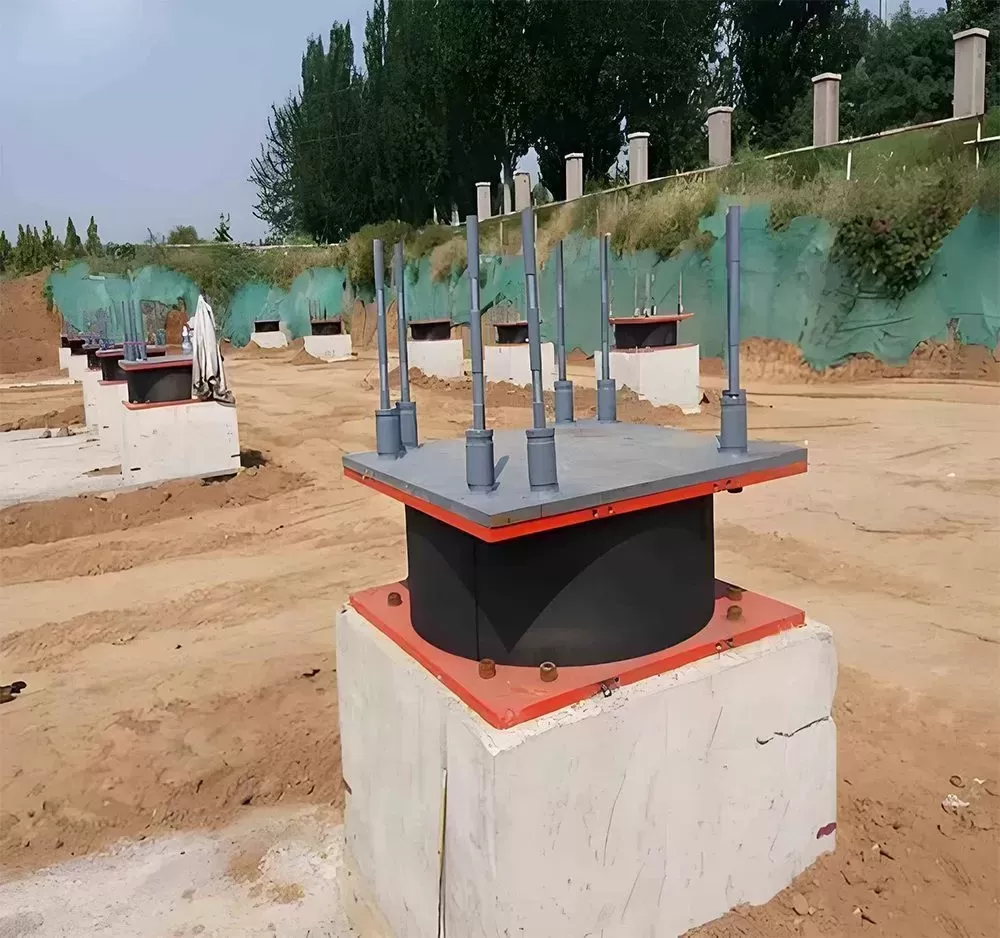
Steel-reinforced units are composite laminated components consisting of alternating layers of vulcanized chloroprene elastomer and high-yield carbon steel shims (typically ASTM A1011 or EN 10025 S275/S355 structural steel plates). The internal steel plates, generally varying between 2 mm and 5 mm in thickness depending on shape factor demands, are treated with chemical bonding adhesives (silane- or phenolic-based primers) and vulcanized under high pressure and temperature.
The steel shims prevent lateral bulging of the internal chloroprene layers, enabling the composite system to sustain service compressive stresses exceeding 12 MPa to 15 MPa while preserving low shear stiffness in the horizontal plane. External top and bottom elastomer cover layers protect the internal steel plates from moisture penetration and atmospheric chemical exposure.
International Design Standards and Quality Verification
Bridge designs must conform to established international codification systems, which prescribe different methodologies for structural verification, testing tolerances, and safety factors.
AASHTO LRFD Bridge Design Specifications
The American Association of State Highway and Transportation Officials (AASHTO) categorizes elastomeric devices into two distinct design frameworks:
Method A: A simplified, conservative design approach applicable to plain or steel-reinforced pads. It sets absolute upper bounds on average compressive stress (typically 7.0 MPa for plain pads, 8.6 MPa for reinforced pads without rotation calculation) and utilizes combined stress verification limits.
Method B: A refined, computationally demanding design framework intended exclusively for steel-reinforced components. The specification of a neoprene bearing under AASHTO Method B requires rigorous evaluation of shear modulus and compressive stress, allowing compressive stress levels to reach up to 12.0 MPa under service loading. Shear strain components—compression ($\gamma_c$), shear ($\gamma_s$), and rotation ($\gamma_r$)—are evaluated simultaneously via interaction expressions:
\gamma_{total} = \gamma_c + \gamma_s + \gamma_r \le 5.0
EN 1337-3 (European Standard for Structural Bearings)
Within the European structural framework, EN 1337-3 regulates laminated and plain elastomeric bearings. The design checks utilize a partial safety factor format, evaluating maximum shear strain ($\epsilon_t$) governed by:
\epsilon_t = K_L(\epsilon_c + \epsilon_q + \epsilon_\alpha) \le \epsilon_{u,d}
Where $\epsilon_c$ is compressive strain, $\epsilon_q$ is shear displacement strain, and $\epsilon_\alpha$ is angular rotation strain. EN 1337-3 also enforces stringent testing for physical durability, including low-temperature crystallization at -25°C for up to 14 days, long-term ozone resistance under dynamic strain, and shear modulus validation under cyclic displacement.
| Mechanical / Material Property | AASHTO M251 Requirement | EN 1337-3 Class A Requirement | Test Standard Reference |
|---|---|---|---|
| Tensile Strength (Min.) | 15.5 MPa (2250 psi) | 16.0 MPa | ASTM D412 / ISO 37 |
| Elongation at Break (Min.) | 400% (for 50 Durometer) | 425% (for 50 Durometer) | ASTM D412 / ISO 37 |
| Shear Modulus ($G$) Range | 0.65 – 0.90 MPa (50 Duro) | 0.70 – 1.15 MPa (Nominal $G=0.9$) | AASHTO M251 Annex A / EN 1337-3 |
| Ozone Resistance | 100 pphm @ 38°C, 100h, 20% strain (No cracks) | 100 pphm @ 40°C, 96h, 30% strain (No cracks) | ASTM D1149 / ISO 1431 |
| Compression Proof Load Test | 150% of maximum design dead + live load | Subjected to vertical stress $\sigma_c \ge 1.5 \times \sigma_{c,max}$ | Full-Scale Physical Hydraulic Rig |
Independent laboratory validation protocols executed by KINGWORK confirm that vulcanized bonding shear strength exceeds the cohesive strength of the rubber compound itself. This guarantees that internal steel-elastomer delamination does not occur prior to the ultimate mechanical failure of the polymer matrix.
Structural Degradation Modes, Pathology, and Mitigation
Structural inspections routinely identify serviceability distress caused by improper site installation, deficient compound formulations, or understated thermal calculations. Addressing these vulnerabilities requires systematic structural troubleshooting:
Surface Fissuring vs. Deep Polymer Cracking
Surface micro-cracking often develops as a result of photo-oxidation when exposed to prolonged ultraviolet radiation. This surface degradation remains benign if crack depths do not exceed 2 mm to 3 mm. Deep horizontal fissure propagation along the edges, conversely, signifies intense ozone degradation or excessive localized shear strain under unanticipated rotational eccentricities. Mitigating this issue requires specifiers to enforce strict compounding criteria featuring high-potency paraphenylenediamine antiozonants.
Unbonded Walking and Dynamic Creep Displacement
Bearings installed on sloping bridge piers without sole-plate levelling or positive mechanical anchoring may experience progressive walking out of the bridge seat. This phenomenon occurs when cyclic thermal expansion, paired with dynamic live-load bounce, causes localized loss of friction during decompression cycles. Structural remedy demands the implementation of external keeper plates, recessed masonry plates, or vulcanized outer steel mounting plates bolted directly to the sub-structure.
Delamination and Core Bulging Distortion
Non-uniform bulging or step-pattern perimeter distortions point directly to internal steel laminate detachment. Causes stem from deficient substrate cleaning, improper adhesive vulcanization curing temperatures, or prolonged exposure of low-grade adhesives to moisture ingress. Laminated structural components must possess completely sealed, homogeneous elastomer edge cover (minimum 4 mm to 6 mm) to isolate structural steel shims from atmospheric and hydrological ingress.
Frequently Asked Questions
What determines the service life of an elastomeric neoprene bearing in marine bridge installations?
Service longevity in marine environments is dictated by the chemical integrity of the chloroprene compound and the protective thickness of the outer elastomer cover. Chloroprene naturally resists salt spray, sea moisture, and mineral degradation far better than standard natural rubber. When compound formulas incorporate optimal carbon black dispersion and antioxidant additives, accompanied by an edge cover layer exceeding 5 mm over all internal steel laminates, service life consistently spans between 40 to 60 years without active structural degradation.
How does temperature affect the shear modulus of chloroprene bearings?
Elastomers demonstrate visco-elastic behaviors dependent on ambient temperatures. As operating temperatures drop below 0°C, chloroprene displays physical stiffening, causing shear modulus ($G$) values to rise moderately. Below -20°C, uncontrolled chloroprene may undergo crystallization, where the polymer chains self-align into semi-crystalline configurations, increasing horizontal stiffness by up to 300% to 400%. Using WRT crystallization-resistant polymers minimizes modulus shifting, protecting piers from excessive cold-weather shear transfer.
Why are steel shims vulcanized inside the elastomer rather than stacked loosely?
Loose stacking of alternating steel plates and rubber sheets fails to induce the internal bonded lateral restraint necessary to control lateral bulging. True structural capacity develops through thermal-pressure vulcanization bonding using reactive chemical primers. This creates chemical cross-links at the molecular boundary between the rubber compound and the metallic oxide layer of the sandblasted steel plates, establishing high shape-factor mechanics and elevated compressive stiffness.
What is the engineering difference between 50, 60, and 70 Durometer hardness in structural elastomeric pads?
Shore A durometer hardness directly correlates with the shear modulus ($G$) and vertical load-bearing capacity of the pad. A 50-durometer pad exhibits a shear modulus of roughly 0.65 to 0.75 MPa, providing superior horizontal flexibility and low rotational resistance for light to medium bridges. A 60-durometer elastomer possesses a nominal $G$ around 0.90 to 1.10 MPa, representing the global standard for highway bridges. A 70-durometer material achieves higher compressive load handling, but its higher shear modulus ($G > 1.30$ MPa) requires expanded elastomeric volume to accommodate horizontal superstructure movements.
Can elastomeric bearings accommodate longitudinal expansion in long-span continuous bridges?
Standard elastomeric laminated bearings can efficiently absorb horizontal displacements up to 50 mm to 70 mm by increasing the overall elastomer height. Beyond this displacement range, excessive bearing heights create geometric instability, compressive rollover tendencies, and construction constraints. For continuous long-span superstructures requiring horizontal movements past 100 mm, bridge bearings combine a steel-laminated elastomeric core with a polished stainless steel top plate and virgin polytetrafluoroethylene (PTFE) sliding interface.
Technical Specification and Project Procurement Support
Selecting the correct elastomeric isolation and load-bearing assembly requires detailed verification of geotechnical foundation parameters, superstructure rotational behaviors, dead and live reaction distributions, and seismic performance limits. Standard catalog parts rarely fulfill the geometric configurations and variable shear modulus boundaries demanded by modern curved, skewed, or continuous bridge alignments.
The engineering team at KINGWORK evaluates boundary condition requirements, reviews project layout specifications, and verifies full alignment with AASHTO M251, EN 1337-3, or custom national infrastructure design provisions. Direct engagement with our engineering department during the preliminary design and bid-preparation phase streamlines the development of customized finite element bearing analyses, shop drawings, non-linear elastomer testing reports, and quality documentation.
To establish detailed mechanical parameters for your structural layout, discuss compounding criteria, or submit formal requests for quotation, transmit your design schedules and engineering drawings directly to our technical sales division for comprehensive review and project estimation.